




Car Speaker Guide: Choosing the Right Sound for Your Drive
Upgrading a car speaker is one of the most effective ways to improve driving comfort. Music lovers, daily commuters, and road trip enthusiasts often face the same question: Which speaker truly enhances my in-car audio experience?
This guide explores real pain points and provides actionable answers, ensuring you select a speaker that matches your expectations and budget.
Why a Quality Car Speaker Matters
A car’s factory-installed speakers are usually designed with cost efficiency in mind rather than superior audio. Over time, distortion, lack of bass, or weak treble frustrate drivers.
Key Features That Define a Good Car Speaker
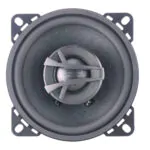
1. Speaker Size and Fitment
The wrong size creates installation issues. Always check your car’s manual or measure existing mounts before buying. Most cars fit 6.5-inch coaxial models, but options vary.
2. Frequency Response
Drivers want music that feels “alive.” A speaker with a wider frequency range reproduces deep bass and sharp highs more accurately.
3. Sensitivity and Power Handling
-
Sensitivity: Measures loudness per watt. Higher sensitivity means louder sound without demanding amplifiers.
-
Power handling (RMS vs peak): Ensures the speaker can manage your amplifier’s output without distortion.
4. Build Quality
Materials such as polypropylene cones, rubber surrounds, and textile tweeters extend lifespan and resist heat and humidity inside vehicles.
Types of Car Speaker and Their Benefits
Coaxial (Full-Range) Speakers
-
Affordable and easy to install.
-
Contain woofer and tweeter in one unit.
-
Best for budget upgrades.
Component Speakers
-
Separate woofers, tweeters, and crossovers.
-
Deliver clearer sound staging.
-
Suitable for enthusiasts seeking premium sound.
Subwoofers
-
Handle deep bass frequencies.
-
Add impact to hip-hop, EDM, or rock.
-
Require additional amplification and space.
How to Choose the Right Car Speaker for Your Needs
Step 1 – Define Your Listening Style
-
Talk radio & podcasts → Coaxial is enough.
-
Music lovers → Component speakers bring life to vocals and instruments.
-
Bass fans → Add a subwoofer for punchy low-end.
Step 2 – Match With Your Car’s Audio System
-
Stock head units → Choose high-sensitivity speakers.
-
Upgraded amplifiers → Select higher RMS-rated units.
Step 3 – Consider Installation and Budget
Some models require professional installation. Balance cost between the product and fitting service to avoid overspending.
Common Problems with Car Audio and How to Solve Them
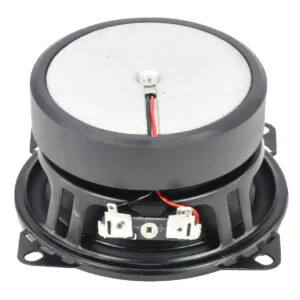
1. Distortion at High Volume
Usually caused by low RMS handling. Solution: select speakers rated for your amplifier’s output.
2. Lack of Bass
Many factory speakers can’t reproduce low frequencies. Adding a subwoofer or choosing larger woofers solves this.
3. Uneven Sound
Placement matters. Tweeters should face listeners for better sound imaging.
4. Short Lifespan
Heat and moisture inside the car damage weak materials. Investing in durable car speaker units prevents early replacement.
Advantages of Upgrading Your Car Speaker
-
Enhanced clarity for both music and speech.
-
More enjoyable long drives with fatigue-free listening.
-
Higher resale value when your vehicle has a quality audio setup.
-
The ability to personalize sound according to taste.
Where to Buy Genuine Car Speaker Units
Only purchase from trusted retailers or official online stores. Fake or low-quality speakers often mimic design but fail to match the sound and durability of genuine models.
Final Thoughts
A well-chosen car speaker transforms the driving experience. By analyzing your needs, matching power requirements, and selecting the right type, you ensure better sound quality and longer service life. Don’t focus only on price — clarity, durability, and fitment are equally important.
FAQ
Q1: Do I need an amplifier for aftermarket car speakers?
Not always. High-sensitivity models work well with stock head units, while powerful speakers benefit from an amplifier.
Q2: Are component speakers worth the price?
Yes, if you value accurate sound staging and clarity. They are preferred by audiophiles.
Q3: Can I install car speakers myself?
Basic coaxial speakers can be DIY-installed, but component systems may require professional help.
Q4: How long do car speakers last?
Quality models typically last 5–10 years, depending on use and climate.


Complimenti per il contenuto! È sempre utile leggere approfondimenti sul
mondo delle biciclette cargo. Anche noi di Green Speedy stiamo lavorando
a nuove soluzioni modulari per rendere la mobilità urbana
più accessibile ed ecologica.
I am not sure where you are getting your info, but great topic.
I needs to spend some time learning more or understanding more.
Thanks for fantastic info I was looking for this info for my
mission.
Saved as a favorite, I love your site!
Wow! Finally I got a blog from where I can really obtain valuable information regarding my study and knowledge.
Mastering Screw Puzzles Advanced Techniques and Strategies
Advanced Strategies for Mastering Screw Puzzles and Enhancing Your Skills
Start by focusing on the configuration of elements rather than just the overall design. Examine how pieces interlock and what movement is required to release each segment. Watch for unique patterns that emerge; often, a single maneuver can lead to multiple openings.
Utilize tools for precision. A simple set of calipers or a protractor can aid in ensuring that you are measuring correctly. Accurate measurements reduce the chance of mistakes when manipulating components, especially in tight spaces where a miscalculation can lead to a jam.
Practice with different varieties of these mechanical conundrums. Each style requires a tailored approach, and familiarity with a range will enhance problem-solving skills. Keep a log of the methods used for each type; this reference can prove crucial during more challenging attempts.
Identify common traps that often lead participants astray. Overlooking the orientation of parts can result in frustration. Analyze configurations methodically, making small adjustments instead of attempting to rush through the process.
Working with a partner or in groups can also provide insights that may be missed when tackling these challenges solo. Discussions around approaches and perspectives often generate new ideas and solutions.
Finally, after overcoming a particularly tough puzzle, take time to reflect on the methods used. Document any insights or innovative approaches that worked well, which will serve as a guide in the future and allow for continual improvement in skills.
Mastering Screw Puzzles: Advanced Techniques and Strategies
A good starting point is to understand the mechanics behind manipulating these interesting constructs. Each piece works in a specific manner, influencing how they interact. Recognizing these relationships can drastically enhance your problem-solving efficiency.
Consider using online simulations before tackling physical versions. This practice allows you to experiment without the pressure of physical consequences, enabling a deeper understanding of piece motions and collaboration.
– Pattern Recognition: Identify recurring sequences within different models. Many share common frameworks. Document these patterns as they often hold the key to resolving similar complexities.
– Spatial Awareness: Develop an ability to visualize movements. This skill lets you plan several steps ahead. Being able to foresee the effects of each turn could save valuable time and effort.
– Trial and Error: Don’t shy away from failing. Each mistake provides insights into the structure and behavior of the components.
Utilizing tools can improve effectiveness. Calipers and measuring sticks are not just for physical work. They can help assess dimensions and track progress accurately as you manipulate parts. Such precision might highlight subtle discrepancies that are easy to overlook.
Consider group dynamics too. Collaborating with fellow enthusiasts can expose you to diverse viewpoints. Different approaches often lead to breakthroughs that solitary efforts might miss. Host regular meetups where each member presents unique creations.
– Document Your Process: Maintain a journal for every attempt, regardless of outcome. This can show evolution in thought processes and techniques over time.
– Set Objectives: Focus on a specific goal for each session. Whether it’s finishing a particular arrangement or perfecting a prior sequence, having a clear target sharpens focus.
– Experiment: Don’t be afraid to stray from standardized methods. Random alterations can sometimes yield unexpected solutions or inspire new techniques.
Reflection is key. After a session, review what worked and what didn’t. This introspection reinforces learning and fosters better strategy development moving forward.
Engaging with online communities adds another layer of insight. Forums and social media groups dedicated to these subjects provide a wealth of shared knowledge. Participants often post videos or detailed breakdowns of their processes, illustrating complex maneuvers that could enhance your understanding.
– Tools and Resources: Leverage downloadable resources for further insight. Tutorials are invaluable in demonstrating new approaches or shortcuts, which could streamline your workflow.
– Building Your Collection: Start with various designs and constructions. A diverse assortment can expose you to numerous techniques, enhancing overall skills.
– Take Breaks: If stuck, stepping away might provide a fresh perspective. Distance can invigorate critical thinking abilities.
Be mindful of time management. While it’s beneficial to invest in understanding more complex structures, it’s equally essential to balance practice with advancement. Setting aside regular time for refining skills while experimenting with new designs ensures ongoing growth.
Documentation becomes a powerful tool when revisiting challenges. A well-maintained record not only allows for tracking progress but also fosters recognition of personal growth over time. Your past struggles become reference points for future endeavors.
Gear your practice towards feeling out the gyroscopic aspects of dynamics. Knowing how pieces move together opens a realm of possibilities. This intimate knowledge enables the reassembly of ideas into innovative configurations.
– Visualization Techniques: Engage in mental rehearsal. Imagine how parts will fit and interchange before actual movement occurs.
– Focus on Flexibility: As you grow more proficient, maintain agility in your thinking. Some of your best insights may come from adapting established practices.
– Seek Feedback: Actively pursue constructive criticism from peers. Their experiences and perspectives can illuminate blind spots in your approach.
The importance of resilience cannot be overstated. Accept setbacks as part of the learning curve. Each failure can redirect your path more clearly to success.
Finally, consider the psychological element. Approach each task with curiosity rather than pressure. Enjoying the process inherently fosters creativity, likely leading to improved outcomes. Enjoy each twist and turn for what it can teach.
Exploring Common Patterns and Techniques for Quick Solutions
Identify the key patterns in your challenge. Frequently, successful participants notice repetitive configurations that can be solved with a similar approach. Pay close attention to movements that appear multiple times; they often indicate an underlying structure. Recognizing these patterns speeds up problem-solving significantly.
Utilize the “block” strategy. When multiple pieces are interlocked or aligned in specific orientations, treat them as a single unit. This simplification can drastically reduce the complexity of your approach. It helps to visualize these blocks as independent entities rather than singular components.
Focus on piece relationships. Often, multiple components work in conjunction to achieve a solution. Assess how pieces interact when moved together and what configurations emerge from such actions. This intersection of pieces can reveal shortcuts previously overlooked.
Employ parity checks. Many configurations will have an odd or even state based on the arrangement of the elements. Regularly assess if you’re maintaining an even number of twists or moves; this will help prevent getting stuck on impossible arrangements.
Incorporate reverse solving. If a specific arrangement proves difficult, try working backward from the solution. Knowing the final arrangement allows for strategic moves in the opposite direction. This technique often illuminates essential steps that may not be apparent when progressing in a forward direction.
Study successful methodologies from other solvers. Engage with communities or forums focused on these challenges; observing others can introduce new approaches or shortcuts that can be adopted for your own practice. Analysis of different solving styles can expose various angles and insights.
Track common missteps. Document errors encountered in solving attempts. Analyzing mistakes helps to avoid repeating them while illuminating recurring issues that may need more focus. Keeping a journal can assist with identifying these patterns over time.
Use the technique of breaking down larger sections. If the entire configuration is overwhelming, focus on one segment at a time. Disassembling the challenge into manageable parts allows for better organization and comprehension of how individual elements interact.
Practice with variations. Change up configurations and orientations to get a better grasp on how different arrangements affect solutions. Variety in practice will refine your skills and familiarize you with common distortions or occurrences.
Identify key moves. Some configurations may require specific moves that are essential to progress. Drill these moves in multiple scenarios until they become second nature. This repetition aids in developing muscle memory, making execution smoother during actual challenges.
Leverage symmetry. Many issues have symmetric elements, and understanding these can provide insights into possible shortcuts. Analyzing symmetry might reveal that certain solutions can be mirrored across various segments, leading to efficiency.
Speed up problem comprehension. Before manipulating, analyze the challenge critically. Determine how pieces fit together and explore the possibilities. This mental mapping often clarifies pathways that might not be obvious through physical handling alone.
Develop a systematic approach. Consistency in your methods can lead to improved efficiency. Establish a routine that you follow each time you start a new challenge. Having a set process will create a framework that supports quicker reasoning.
Collaborate with others. Working with fellow enthusiasts can lead to shared insights and help in learning from different perspectives. Group problem-solving can spawn innovative techniques that might not surface during individual efforts.
Incorporate timed practice. Set time limits for solving challenges to hone your speed as well as your accuracy. Learning to work under pressure prepares you mentally for quicker assessments while maintaining focus on achieving the correct outcome.
Refine hand positioning. The way you hold and manipulate components can affect the speed of your solving methods. Experiment with different grips to find the most efficient stance that allows for fluid motion during rotation or repositioning.
Utilize visual cues. Sketch out configurations or note down move sequences that seem effective. Creating a visual representation often clarifies thoughts and highlights areas that need adjustment without having to dismantle everything physically.
Reassess your techniques regularly. As you improve, periodically reevaluate your approaches. This self-assessment can unveil areas needing more focus or new methodologies that have emerged in the community.
Underlying all these suggestions is the need for continued practice and adjustment. Regularly applying these methods not only solidifies your understanding but also develops intuition for recognizing quicker paths to resolution.
https://rtware.net/
Good day! I could have sworn I’ve been to this site before but after browsing through some of the articles I realized it’s
new to me. Anyways, I’m certainly delighted I stumbled upon it and
I’ll be bookmarking it and checking back often!
This design is incredible! You definitely know how to keep a reader entertained.
Between your wit and your videos, I was almost
moved to start my own blog (well, almost…HaHa!) Great
job. I really enjoyed what you had to say, and more than that, how you presented it.
Too cool!
Attractive section of content. I just stumbled upon your web site and in accession capital to assert
that I acquire in fact enjoyed account your
blog posts. Any way I will be subscribing to your augment and even I
achievement you access consistently rapidly.
For most up-to-date news you have to go to see internet and on the web I found this site as a finest site
for newest updates.
Идеальные торты на заказ — для детей и взрослых. Поможем выбрать начинку, оформление и размер. Десерт будет вкусным, свежим и полностью соответствующим вашей идее.