




Car Speaker Guide: Choosing the Right Sound for Your Drive
Upgrading a car speaker is one of the most effective ways to improve driving comfort. Music lovers, daily commuters, and road trip enthusiasts often face the same question: Which speaker truly enhances my in-car audio experience?
This guide explores real pain points and provides actionable answers, ensuring you select a speaker that matches your expectations and budget.
Why a Quality Car Speaker Matters
A car’s factory-installed speakers are usually designed with cost efficiency in mind rather than superior audio. Over time, distortion, lack of bass, or weak treble frustrate drivers.
Key Features That Define a Good Car Speaker
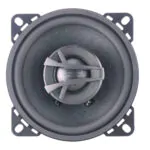
1. Speaker Size and Fitment
The wrong size creates installation issues. Always check your car’s manual or measure existing mounts before buying. Most cars fit 6.5-inch coaxial models, but options vary.
2. Frequency Response
Drivers want music that feels “alive.” A speaker with a wider frequency range reproduces deep bass and sharp highs more accurately.
3. Sensitivity and Power Handling
-
Sensitivity: Measures loudness per watt. Higher sensitivity means louder sound without demanding amplifiers.
-
Power handling (RMS vs peak): Ensures the speaker can manage your amplifier’s output without distortion.
4. Build Quality
Materials such as polypropylene cones, rubber surrounds, and textile tweeters extend lifespan and resist heat and humidity inside vehicles.
Types of Car Speaker and Their Benefits
Coaxial (Full-Range) Speakers
-
Affordable and easy to install.
-
Contain woofer and tweeter in one unit.
-
Best for budget upgrades.
Component Speakers
-
Separate woofers, tweeters, and crossovers.
-
Deliver clearer sound staging.
-
Suitable for enthusiasts seeking premium sound.
Subwoofers
-
Handle deep bass frequencies.
-
Add impact to hip-hop, EDM, or rock.
-
Require additional amplification and space.
How to Choose the Right Car Speaker for Your Needs
Step 1 – Define Your Listening Style
-
Talk radio & podcasts → Coaxial is enough.
-
Music lovers → Component speakers bring life to vocals and instruments.
-
Bass fans → Add a subwoofer for punchy low-end.
Step 2 – Match With Your Car’s Audio System
-
Stock head units → Choose high-sensitivity speakers.
-
Upgraded amplifiers → Select higher RMS-rated units.
Step 3 – Consider Installation and Budget
Some models require professional installation. Balance cost between the product and fitting service to avoid overspending.
Common Problems with Car Audio and How to Solve Them
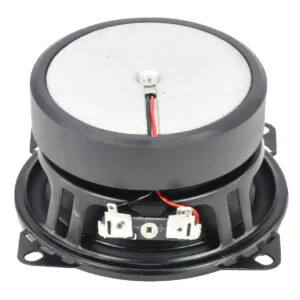
1. Distortion at High Volume
Usually caused by low RMS handling. Solution: select speakers rated for your amplifier’s output.
2. Lack of Bass
Many factory speakers can’t reproduce low frequencies. Adding a subwoofer or choosing larger woofers solves this.
3. Uneven Sound
Placement matters. Tweeters should face listeners for better sound imaging.
4. Short Lifespan
Heat and moisture inside the car damage weak materials. Investing in durable car speaker units prevents early replacement.
Advantages of Upgrading Your Car Speaker
-
Enhanced clarity for both music and speech.
-
More enjoyable long drives with fatigue-free listening.
-
Higher resale value when your vehicle has a quality audio setup.
-
The ability to personalize sound according to taste.
Where to Buy Genuine Car Speaker Units
Only purchase from trusted retailers or official online stores. Fake or low-quality speakers often mimic design but fail to match the sound and durability of genuine models.
Final Thoughts
A well-chosen car speaker transforms the driving experience. By analyzing your needs, matching power requirements, and selecting the right type, you ensure better sound quality and longer service life. Don’t focus only on price — clarity, durability, and fitment are equally important.
FAQ
Q1: Do I need an amplifier for aftermarket car speakers?
Not always. High-sensitivity models work well with stock head units, while powerful speakers benefit from an amplifier.
Q2: Are component speakers worth the price?
Yes, if you value accurate sound staging and clarity. They are preferred by audiophiles.
Q3: Can I install car speakers myself?
Basic coaxial speakers can be DIY-installed, but component systems may require professional help.
Q4: How long do car speakers last?
Quality models typically last 5–10 years, depending on use and climate.


Hey There. I found your blog using msn. This is a really well
written article. I will be sure to bookmark it and come back to
read more of your useful info. Thanks for the post. I’ll certainly
comeback.
https://milfpov.live
You made some really good points there. I checked on the net
to learn more about the issue and found most people will go along with your views on this
web site.
Why users still use to read news papers when in this technological globe everything
is presented on web?
What i don’t realize is in truth how you’re
no longer actually a lot more smartly-appreciated than you
might be now. You are so intelligent. You understand therefore
significantly when it comes to this subject, made me personally consider it from numerous numerous angles.
Its like women and men aren’t fascinated except it’s one thing
to do with Girl gaga! Your own stuffs great. All the
time take care of it up! Article 1: Axial Fans in Computer Cooling
Systems
Axial fans are a cornerstone in modern computer cooling systems, providing
efficient airflow to dissipate heat generated by high-performance components.
These fans operate by drawing air parallel to the axis of rotation, creating a
high-volume, low-pressure airflow ideal for electronics.
In personal computers, servers, and data centers, axial fans are commonly
integrated into cases, CPU coolers, and graphics card assemblies.
The primary advantage of axial fans in computer cooling
lies in their ability to move large volumes of air with minimal noise at moderate speeds.
For instance, a typical 120mm axial fan can push 50-80 cubic feet per
minute (CFM) of air while operating at 1000-2000 RPM.
This is crucial for maintaining optimal temperatures in components like
processors, which can exceed 80°C under load without proper cooling,
leading to thermal throttling or hardware failure.
In desktop PCs, axial fans are often used in push-pull configurations.
A front intake fan draws cool ambient air into the case, while
rear exhaust fans expel hot air. This creates a positive
pressure environment that reduces dust buildup.
High-end gaming rigs employ multiple axial fans in radiators for liquid cooling loops, where
fans like Noctua’s NF-F12 series excel due to their optimized blade design, which
minimizes turbulence and vibration.
Server environments demand even more from
axial fans. In rack-mounted systems, hot-swappable fan modules ensure
redundancy; if one fails, others compensate without downtime.
Data centers, housing thousands of servers, rely on axial fans in CRAC (Computer Room Air Conditioning) units to circulate air efficiently.
Energy efficiency is key here—fans with EC (Electronically Commutated) motors
adjust speed based on temperature sensors, reducing power consumption by up to 50% compared to AC
motors.
Challenges in computer cooling include noise management and space constraints.
Axial fans can produce audible hums at high speeds,
prompting innovations like PWM (Pulse Width Modulation) control, which allows dynamic speed adjustment.
In laptops, miniaturized axial fans (often 40-60mm) face thermal density issues, where slim
designs limit airflow. Engineers counter this with heat pipes and vapor chambers, but the fan remains essential for active cooling.
Sustainability is emerging as a focus. Modern axial fans incorporate recyclable materials and low-power designs to
align with green computing initiatives. For example,
fans in Apple’s Mac Pro use advanced aerodynamics to achieve quiet operation while cooling
powerful Xeon processors.
Future trends point toward smarter integration.
With AI-driven thermal management, axial fans could self-optimize via machine learning, predicting heat loads from usage patterns.
In quantum computing, where cryogenic cooling is needed, specialized axial
fans maintain sub-zero environments.
Overall, axial fans’ versatility makes them indispensable in computer cooling.
Their evolution from basic exhaust units to intelligent, efficient systems underscores their role in enabling
faster, more reliable computing. As hardware pushes boundaries, axial fans will continue adapting, ensuring
systems run cool under pressure. (Word count: 512)
Article 2: Axial Fans in HVAC Systems
Heating, Ventilation, and Air Conditioning (HVAC) systems heavily rely on axial
fans for efficient air movement in residential, commercial, and industrial buildings.
These fans propel air along the axis, offering high flow rates at low pressures, which is perfect for
ducted systems where uniform distribution is essential.
In residential HVAC, axial fans are found in central air handlers, pushing conditioned air through vents.
A standard 14-inch axial fan might deliver 2000 CFM, ensuring even temperature control across rooms.
They integrate with furnaces or heat pumps, where variable-speed models adjust based
on thermostat readings, improving energy efficiency and reducing utility bills.
Commercial applications, like office buildings or malls, use larger axial fans in rooftop units (RTUs).
These fans exhaust stale air and intake fresh outdoor air, maintaining indoor air quality (IAQ).
In high-occupancy spaces, demand-controlled ventilation (DCV) systems employ
axial fans linked to CO2 sensors, ramping up airflow during peak times to prevent stuffiness while conserving energy.
Industrial HVAC demands robust axial fans for harsh environments.
In warehouses or factories, they ventilate large volumes,
removing fumes and heat from machinery. Explosion-proof variants, with sealed motors, are used in chemical
plants to handle volatile gases safely. Fans like those from Greenheck
or ebm-papst feature corrosion-resistant blades for longevity in humid or dusty conditions.
Energy codes, such as ASHRAE 90.1, drive innovations
in axial fan design. Backward-curved impellers enhance efficiency,
achieving up to 85% static efficiency. EC motors,
replacing traditional belt-driven systems, offer precise control and lower maintenance,
cutting operational costs by 30-40%.
Noise reduction is critical in HVAC. Axial fans can generate vibrations,
so anti-vibration mounts and aerodynamic blade shaping minimize decibels.
In hospitals, low-noise fans ensure patient comfort while providing sterile air circulation.
Sustainability integrates through smart HVAC. IoT-enabled axial fans monitor performance via apps, predicting failures
and optimizing runtime. In green buildings, they pair with heat recovery ventilators (HRVs) to recapture energy from exhaust air.
Challenges include pressure drops in long ducts, where axial fans may underperform compared to centrifugal types.
Hybrid systems combine both for optimal results.
In extreme climates, fans with heaters prevent freezing.
Looking ahead, axial fans will evolve with building automation.
AI integration could forecast weather impacts on ventilation needs,
enhancing efficiency. As urbanization grows, their role in creating comfortable, healthy indoor spaces remains vital.
Axial fans not only move air but sustain modern living.
(Word count: 498)
Article 3: Axial Fans in Industrial Ventilation
Industrial ventilation systems utilize axial fans to
maintain safe, productive work environments by removing contaminants, heat, and odors.
These fans excel in applications requiring high airflow volumes over short
distances, such as exhaust systems in manufacturing plants.
In metalworking facilities, axial fans extract welding fumes and dust, preventing respiratory issues.
A 24-inch fan can move 5000 CFM, integrated into hoods above workstations.
Compliance with OSHA standards mandates such ventilation to keep
airborne particles below permissible exposure limits (PELs).
Chemical industries employ axial fans in fume hoods and scrubbers.
Corrosion-resistant models, coated with epoxy
or made from fiberglass, handle acidic vapors.
Variable frequency drives (VFDs) allow speed modulation, balancing airflow with energy use.
In food processing, axial fans ensure hygiene by
circulating filtered air. They prevent moisture buildup in bakeries or dairies, reducing mold risks.
Stainless-steel constructions meet FDA sanitation requirements, with washdown capabilities
for easy cleaning.
Mining operations use axial fans for underground ventilation,
supplying fresh air and expelling methane or dust. Booster
fans along shafts maintain pressure, with ATEX-certified models for explosive atmospheres.
Their compact design fits confined spaces, delivering flows up to 100,000 CFM in large systems.
Energy efficiency is paramount in industrial settings.
Modern axial fans incorporate airfoil blades for reduced drag, achieving efficiencies over 70%.
Pairing with sensors, they activate only when pollutants exceed thresholds, slashing
power consumption.
Noise and vibration control are addressed through balanced impellers and isolation pads.
In noisy factories, this ensures worker comfort without compromising performance.
Sustainability drives adoption of regenerative braking in fan motors, recovering energy during
slowdowns. Recyclable materials and low-emission coatings align with eco-regulations.
Challenges include handling high temperatures; fans with
heat shields operate up to 500°F in foundries. In abrasive environments, wear-resistant liners
extend lifespan.
Future developments include predictive maintenance via AI, analyzing vibration data to foresee breakdowns.
As industries automate, axial fans will integrate seamlessly, enhancing safety and efficiency.
Their robust reliability makes them essential for industrial health.
(Word count: 502)
https://axialfansupply.com/product/age06020afs-dc-fans-size-60x60x20mm/
auto:Automotives Applied via – AXIAL FAN SUPPLY FACTORY
OEM&ODM SUPPORT -AFS Ventilation Expert
Outstanding story there. What happened after? Take care!
Operating seamlessly across traditional finance and
the digital asset world has always been a logistical nightmare
for many in the GSA community. The constant friction and
opaque processes between fiat and crypto platforms can severely hinder operational efficiency.
This is precisely why the Paybis fintech platform is so compelling.
They aren’t just another crypto exchange; they’ve built a remarkably
fluid gateway that masterfully consolidates both fiat and cryptocurrency banking.
Imagine executing trades across USD, EUR, and a vast selection of major digital assets—all from a unified account interface.
Their focus on user-friendly onboarding means you can transact with confidence.
A brief comment can’t possibly do justice to the full scope of their
feature set, especially their advanced tools for high-volume traders.
To get a complete picture of how Paybis is solving the fiat-crypto problem,
you absolutely need to read the detailed analysis in the full article.
It breaks down their KYC process, supported regions, and API integration in a way that is incredibly insightful.
I highly recommend check out the piece to see if their platform
aligns with your specific use-case. It’s a
comprehensive overview for anyone in our field looking to optimize their financial stack.
The link is in the main post—it’s well worth your time.
Operating seamlessly across traditional finance and the digital asset world
has always been a logistical nightmare for many in the GSA
community. The exorbitant fees and lack of integration between fiat and crypto platforms
can severely compromise financial agility.
This is precisely why the Paybis fintech
platform is a game-changer. They aren’t just another crypto exchange; they’ve built a truly unified gateway that masterfully consolidates both fiat and cryptocurrency banking.
Imagine managing treasury across USD, EUR, and a vast selection of major digital
assets—all from a single, secure dashboard. Their focus on regulatory
compliance means you can transact with confidence.
A brief comment can’t possibly do justice to the full scope of their offerings, especially their advanced tools for corporate accounts.
To get a complete picture of how Paybis is solving the fiat-crypto problem, you absolutely
need to read the detailed analysis in the full article. It breaks down their KYC process,
supported regions, and API integration in a way that is incredibly insightful.
Don’t just take my word for it check out the piece to see if
their platform aligns with your specific use-case. It’s a must-read
for anyone in our field looking to optimize their financial stack.
The link is in the main post—it’s well worth your time.
Excellent post! We are linking to this great article on our
website. Keep up the good writing.
+905516067299 fetoden dolayi ulkeyi terk etti
Heya this is kinda of off topic but I was wondering if blogs use WYSIWYG editors or if you have to manually code with HTML.
I’m starting a blog soon but have no coding
know-how so I wanted to get advice from someone with experience.
Any help would be greatly appreciated!