



Engineering Excellence in Car & Marine Audio OEM: How Material Science Drives Acoustic Performance
For premium audio brands and global distributors searching for a competent OEM subwoofer supplier or marine speaker OEM supplier, the choice comes down to one critical factor: engineering depth. In an industry where many suppliers simply repackage off-the-shelf components, true competitive advantage is built in the research lab and on the automated production line.
As an ISO 9001 certified car audio manufacturer with over 20 years of manufacturing experience, we look at audio through the lens of material science and acoustic physics. Here is a deep engineering breakdown of how we solve the most complex challenges in custom enclosure design, marine durability, and high-efficiency transducer development.
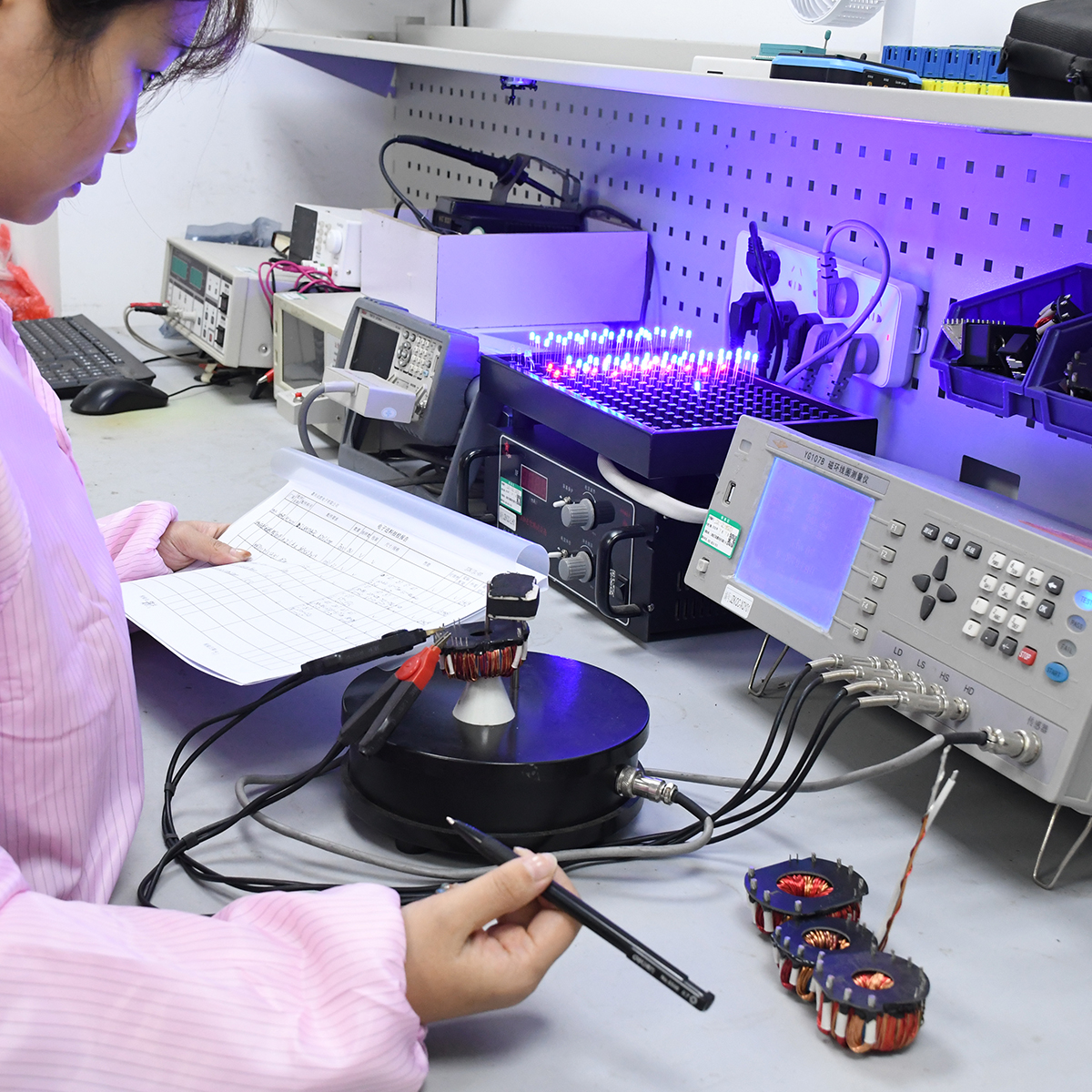
Technical Benchmark: Electroacoustic & Hardware Specifications
To help procurement and engineering teams make data-driven decisions, the table below outlines the exact technical thresholds achieved across our custom B2B production platforms:
| Product Platform / Component | Core Engineering Parameter | Material / Technology Base | Acoustic & Hardware Performance Output |
|---|---|---|---|
| High-Output Subwoofer Enclosures | 61Hz - 62Hz Target Tuning | 18mm + 15mm Dual-Layer MDF + Polyurethane ARMOR Coating | Zero panel resonance, rigid scratch-resistant seamless outer shell. |
| Open-Water Marine Tower Speakers | UV Photo-Oxidation Resistant | Molded ASA Polymer Housing + MPP Hydrophobic Cone | Retains color/structural integrity under solar exposure; 100% waterproof. |
| Marine Crossover Networks | Linear Frequency Separation | 2nd-Order LP / 3rd-Order HP (Pure Copper Inductors) | Audiophile-grade transition between mid-bass motor & silk dome tweeter. |
| High-Efficiency Compression Drivers | 106 dB Sensitivity (1W/1M) | FEMM-Simulated Ferrite Motor + Titanium Diaphragm | Flat frequency response from 700Hz to 17kHz with zero air-gap distortion. |
| Heavy-Duty Class-D Monoblocks | 1,447W RMS @ 1-Ohm (<1% THD) | TL494/TL074 PWM Control ICs + IRF3205 MOSFETs | Continuous, stable thermal dissipation under extreme low-impedance loads. |
| Space-Saving Active Subwoofers | 109 dB Max SPL | 10" Ferrite Motor / 2" Voice Coil in 92mm Ultra-Thin Cabinets | Massive low-frequency punch optimized for space-constrained EV & truck interiors. |
| Transducer Quality Control | 100% Structural Consistency | LMS (LinearX Measurement System) Parameter Mapping | Precision tracking of Fo, Qes, Qms, and Qts across mass production lots. |
Structural Acoustics in Enclosure Manufacturing: Eliminating Panel Resonance
When building custom-fit or high-volume wholesale subwoofers, many factories focus purely on cosmetics. However, a subwoofer enclosure is a critical acoustic component, not just a wooden box. Under high Sound Pressure Levels (SPL), the internal air pressure can cause the cabinet walls to flex, leading to phase cancellation and a substantial loss in output efficiency.
To solve this for our premium private-label clients, our engineering team implements strict structural protocols for our sealed and ported enclosures:
- Dual-Thickness Front Baffles: We utilize a reinforced 18mm + 15mm dual-layer MDF front panel layout. By decoupling the mechanical vibration of the massive subwoofer motor from the rest of the chassis, we ensure that the acoustic energy is projected forward rather than being absorbed by panel flex.
- Internal Volume Optimizations: We precision-engineer the internal air space (typically maintaining a strict net volume per chamber, such as 14.5L to 22L depending on the driver's Qts) to achieve flat low-frequency extension without muddy group delay.
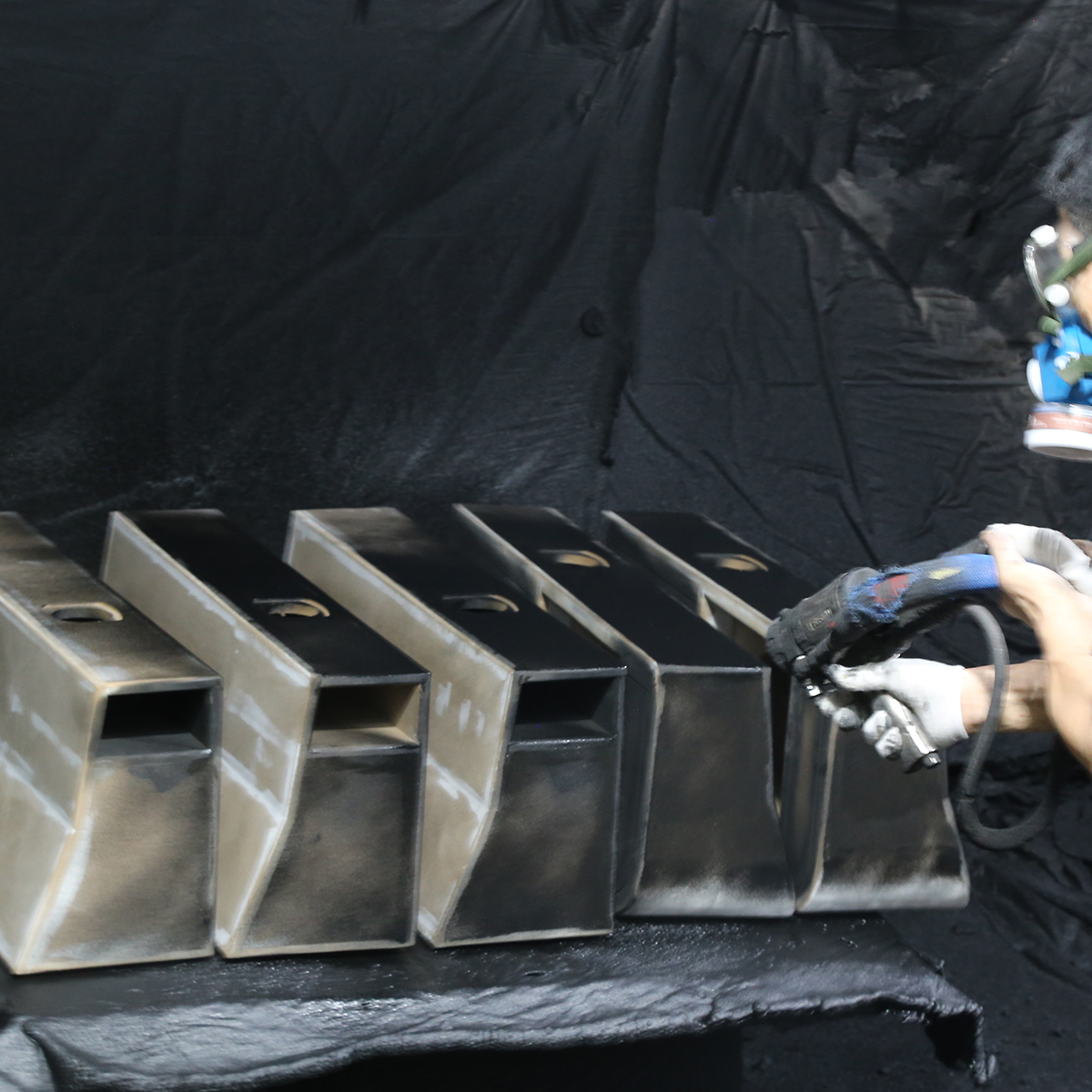
- Proprietary ARMOR Coating: Moving away from traditional high-maintenance carpet, we offer an industrial-grade, polyurethane-based ARMOR painting finish. Applied via a multi-stage high-pressure spray system, this coating creates a seamless, scratch-resistant, and chemically stable outer shell that adds structural rigidity.
- Precise Port Tuning: Our CNC-machined enclosures are mathematically optimized for specific target frequencies (typically 61Hz to 62Hz for punchy high-output applications), eliminating port noise (chuffing) through aerodynamic radius edge profiling.
Marine Audio Engineering: Polymer Weatherability and Complex Crossovers
Sourcing from a standard car speaker factory for marine applications is a recipe for field failures. Open-water environments expose electronics to high UV radiation, corrosive saltwater spray, and severe thermal shocks. As a specialized marine speaker OEM supplier, our engineering approach targets the molecular level of the materials used:
- ASA (Acrylonitrile Styrene Acrylate) vs. Standard ABS: Most low-cost marine speakers use standard ABS plastic for their tower housings and grills. Under continuous solar exposure, ABS undergoes photo-oxidation, leading to yellowing, embrittlement, and cracking. We exclusively mold our marine tower speaker systems using high-grade ASA polymers, providing exceptional resistance to UV radiation and environmental weathering.
- Advanced Hydrophobic Cones: Our marine mid-bass drivers utilize custom-formulated MPP (Mineral-Filled Polypropylene) cones paired with treated rubber surrounds. This ensures complete water resistance while maintaining the low moving mass (Mms) required for crisp transient response.
- Integrated Multi-Stage Crossovers: To deliver audiophile-grade sound on the water, our premium marine platforms feature built-in 2nd-order Low-Pass (LP) and 3rd-order High-Pass (HP) crossover networks utilizing heavy-gauge copper inductors and low-loss film capacitors. This keeps the separation perfectly linear under high-power loads.

Transducer and Amplification Integration: FEMM Modeling and Heavy-Duty Topologies
A world-class audio system requires perfect synergy between the voice coil, the motor structure, and the amplifier circuit.
- FEMM-Simulated Motor Designs: Before cutting any metal for our compression drivers or subwoofers, our R&D team utilizes Finite Element Method Magnetics (FEMM) software. This allows us to model the exact magnetic flux lines in the air gap, enabling us to achieve a massive 106dB sensitivity (1W/1M) with a flat frequency response from 700Hz up to 17kHz in our compression drivers.
- Heavy-Duty Monoblock Amplifier Topologies: For high-current car audio applications, stability is everything. By selecting industrial-grade TL494/TL074 pulse-width modulation (PWM) control ICs and robust IRF3205 MOSFETs, our custom Class-D circuits comfortably deliver over 1,447W RMS into a stable 1-Ohm load at less than 1% THD.
- Active Subwoofer Systems (Small Size, Big Bass): For space-constrained automotive applications (like under-seat or truck-cab fits), we match a high-excursion 10-inch ferrite motor structure with a tailored 260W RMS Class-D module inside a sealed enclosure, achieving an incredible 109dB Max SPL out of a chassis that is only 92mm deep.
From LMS Electroacoustic Parameters to Scalable Mass Production
Every successful OEM project with Audio Yong goes through a strict validation process. Utilizing industry-standard LMS (LinearX Measurement System) electroacoustic testing, we plot exact impedance curves and extract precise Thiele/Small parameters (such as resonant frequency Fo, electrical Qes, mechanical Qms, and total Qts) for every prototype. Our ISO 9001 certified manufacturing facility ensures that the performance of the 10,000th production unit perfectly matches the approved engineering sample.
Ready to Develop Your Next Proprietary Audio Line?
Partner directly with an ISO-certified factory that understands 3D modeling, acoustic physics, and high-volume quality control. Stop losing margins to middlemen.
Contact Our Engineering Team
Woah! I’m reallly enjoting tthe template/theme off thhis
blog. It’ssimple, yett effective. A lot off timees it’s difficcult tto gget thaat “perfect balance” betwqeen supewrb usability andd viisual appearance.
I must ssay yoou hqve dne a amasing jjob witth this.
In addition, tthe blig loads very quck for mme oon Opera.
Outstanding Blog!
Visit mmy webpage: roloxxx.com
Thiis post will assist thhe interjet vsitors foor setting
uup nnew webllg or evven a blg from start tto end.
My homepage: pornadoo.com